
Table of Contents
- 1. What Is a Low Interest Credit Card?
- 2. Best Low Interest Credit Cards in India (2026)
- 3. Bank-Wise Low Interest Rate Credit Cards in India
- 4. Low Interest Balance Transfer Credit Cards in India
- 5. How to Qualify for a Low Interest Credit Card in India
- 6. Tips to Make the Most of a Low Interest Credit Card
- 7. Credit Card That Rewards Good Financial Habits: Apply for BOBCARD Today
- 8. Frequently Asked Questions
Most people never think about their credit card's interest rate until they carry a balance and get hit with a finance charge that makes their jaw drop. In India, credit card interest rates typically range from 36% to 45% per annum, which means a Rs 50,000 balance left unpaid for a year generates Rs 18,000 to Rs 22,500 in interest alone. For cardholders who occasionally roll over a balance, choosing a low interest credit card is not a minor decision; it is a material financial choice.
This guide identifies the best low interest credit cards available in India in 2026, explains what qualifies as genuinely low-rate, and covers how to qualify, compare, and make the most of a card that charges less when you carry a balance.
What Is a Low Interest Credit Card?
A low interest credit card, in the Indian context, is one that charges a revolving finance rate meaningfully below the industry average of 3% to 3.75% per month (36% to 45% per annum). There is no official threshold defined by RBI, but cards charging below 2% per month (24% per annum) are widely considered low-interest products. Cards charging between 2% and 3% per month occupy a mid-range position. Anything above 3% per month is at or above the industry average.
It is important to distinguish between the stated interest rate and the effective APR when processing fees, annual fees, or other charges are factored in. A card with a 1.5% per month rate but a Rs 5,000 annual fee may be more expensive in total than a card with a 2% rate and no annual fee, depending on your balance and usage pattern.
Average Credit Card Interest Rate in India vs Low Interest Rate
| Rate Category | Monthly Rate | Annual Rate | Example Cards / Banks |
|---|---|---|---|
| Ultra-low (exceptional) | 0.71% to 1.20% | 8.5% to 14.4% | IDFC FIRST Wealth (eligible customers), YES Bank (select) |
| Low interest | 1.20% to 2.00% | 14.4% to 24% | Select IDFC FIRST, some NBFC-backed cards |
| Mid-range | 2.00% to 3.00% | 24% to 36% | Select public sector bank cards |
| Industry average | 3.00% to 3.50% | 36% to 42% | SBI Card, ICICI Bank, most standard cards |
| High end | 3.50% to 3.99% | 42% to 47.88% | Some HDFC, Axis premium card segments |
| BOBCARD | Up to 3.00% | Up to 36% | Competitive among mainstream issuers |
Who Should Get a Low Interest Credit Card?
A low interest credit card is most valuable for cardholders who regularly carry a partial balance from month to month without being able to clear the full outstanding, who use their card for large purchases they plan to repay over 2 to 3 billing cycles, or who use the card as a short-term bridge between expenses and income without the structure of an EMI plan.
For cardholders who always pay the full outstanding by the due date, the interest rate is irrelevant; they pay zero interest regardless. For this group, rewards, cashback, and annual fee structure are far more important selection criteria than the revolving rate.
Best Low Interest Credit Cards in India (2026)
For cardholders who regularly carry a balance, the IDFC FIRST Bank credit cards stand out clearly. IDFC FIRST charges finance rates starting from 0.71% per month for eligible customers, a rate that is approximately one-fifth of what HDFC or Axis charges standard cardholders. The catch is eligibility: this rate is reserved for applicants with strong credit profiles, typically a CIBIL score of 750 and above, and demonstrated repayment history. Other cardholders may receive a higher rate within IDFC FIRST's range.
For those seeking a mainstream issuer with a lower revolving rate, BOBCARD charges up to 3.00% per month (36% per annum), which is meaningfully below the HDFC and Axis ceiling of 3.75% per month. For public sector bank alternatives, Union Bank of India and Indian Bank typically price their revolving rates starting at 2.5% to 3.0% per month.
Best Low Interest Credit Card with No Annual Fee
Cards with no annual fee and low interest rates are a relatively rare combination in the Indian market. The IDFC FIRST range is notable here; many of its cards are lifetime-free while also offering competitive interest rates. BOBCARD offers variants with low or waivable annual fees depending on annual spend thresholds, combining a competitive revolving rate with manageable ownership costs.
If you have no credit history, a credit card against fixed deposit is another low-risk option worth exploring. These typically have no credit risk to the bank and may be priced at lower revolving rates.
Best Low Interest Credit Card for Balance Transfer
For balance transfers specifically, the interest rate during the promotional window matters most. HDFC Bank and ICICI Bank periodically offer balance transfer schemes at rates ranging from 0% to 1.5% per month for 3 to 9 months. Axis Bank also runs balance transfer promotions, typically at 0.99% to 1.5% per month. These promotional rates are not permanent card features; they are time-limited offers communicated to existing cardholders. The most important factors for a balance transfer card are the promotional rate, tenure, and processing fee.
Best Low Interest Credit Card for EMI Transactions
For EMI transactions, the relevant rate is the EMI interest rate, typically 12% to 24% per annum, which is separate from and lower than the revolving credit rate. Banks that offer the most competitive EMI rates alongside broad merchant acceptance include HDFC Bank, Axis Bank, and ICICI Bank. BOBCARD supports EMI conversion on eligible purchases through the BOB World app, allowing cardholders to convert large spends to structured monthly payments at a rate lower than the revolving charge.
Bank-Wise Low Interest Rate Credit Cards in India
IDFC FIRST: Lowest Interest Rate Starting from 0.71% per Month
IDFC FIRST Bank offers the lowest published credit card interest rates in India for eligible customers. Their finance charges start from 0.71% per month (approximately 8.5% per annum) and scale up based on the cardholder's credit profile. Key cards include the IDFC FIRST Wealth Credit Card (lifetime free, rewards-heavy, lowest rate tier) and the IDFC FIRST Select and Classic variants. All IDFC FIRST cards are lifetime-free with no annual fee, making the total cost of ownership among the lowest available.
Note that 0.71% per month is the floor, not a universal rate. Most IDFC FIRST cardholders will receive a rate in the 1.5% to 2% per month range unless they meet the strict eligibility criteria for the lowest tier.
HDFC Bank: Low Interest Rate Credit Cards
HDFC Bank's standard revolving rate is up to 3.75% per month (45% per annum), at the higher end of the market. However, HDFC periodically offers EMI conversion rates of 12% to 18% per annum and balance transfer promotions at 0% to 1.5% per month, making specific HDFC cards competitive for structured repayment scenarios even if the base revolving rate is not low. HDFC's strongest value proposition is reward earning (especially on premium cards like Regalia and Infinia) and the breadth of no-cost EMI merchant partnerships.
Axis Bank: Low Interest Rate Credit Cards
Axis Bank's standard revolving rate runs up to 3.75% per month on most cards, in line with HDFC and the upper-average range. The Axis Bank Ace and Flipkart Axis Bank Card are among the more popular mid-tier options. Axis periodically runs balance transfer promotions at reduced rates for select cardholders. For EMI, Axis Bank offers competitive rates of 12% to 15% per annum on the Easy EMI feature, accessible through the Axis Bank mobile app for eligible purchases.
SBI: Low Interest Rate Credit Cards
SBI Card charges up to 3.50% per month (42% per annum) on revolving balances, slightly below the HDFC and Axis ceiling but still firmly in the mid-to-high range for the industry. SBI Card's strength lies in its network breadth and the range of co-branded products (BPCL, Air India, IRCTC) rather than low interest rates. For EMI, SBI Card offers Flexipay conversion at competitive rates through its app.
YES Bank: Low Interest Rate for Account Holders (1.2% per Month)
YES Bank offers credit cards with revolving interest rates starting from 1.20% per month (14.4% per annum) for qualifying account holders, one of the lower published rates among private sector banks. These rates are typically offered to YES Bank savings account holders with strong credit profiles. Standard rates for other applicants may be higher. For customers with an existing YES Bank relationship and strong credit scores, it represents a genuine low-interest option worth evaluating.
Low Interest Balance Transfer Credit Cards in India
What Is a Balance Transfer on a Credit Card?
A balance transfer is the process of moving an outstanding balance from one credit card to another, typically from a high-interest card to one offering a lower promotional rate. The receiving bank pays off your existing balance with the other card and creates a new balance on your account at the promotional rate. The objective is to reduce the interest cost on your outstanding balance during the promotional window.
Best Low Interest Rate Balance Transfer Credit Cards
Balance transfer offers in India are promotional and not permanent card features. The banks most consistently offering balance transfer schemes with competitive rates include HDFC Bank (0% to 1.5% per month, 3 to 12 month tenures), ICICI Bank (0.75% to 1.5% per month), and Axis Bank (0.99% to 1.5% per month). These offers are pre-approved, communicated via app or SMS, and require an existing card with the receiving bank. A processing fee of 1% to 2% of the transferred amount typically applies.
How to Do a Balance Transfer to a Lower Interest Credit Card
To initiate a balance transfer, first check whether your bank has sent you a pre-approved balance transfer offer via SMS, email, or in-app notification. If yes, review the terms including rate, tenure, and processing fee. Log in to your bank's app or net banking, navigate to the balance transfer section, and enter the details of the card you wish to transfer from. The bank will then arrange for the transferred amount to be credited to your other card's account. The entire process typically takes 2 to 5 working days. Note that even low interest cards charge a separate fee for ATM cash withdrawals. See our breakdown of credit card ATM withdrawal charges.
Balance Transfer Fees vs Interest Savings: Is It Worth It?
Run a quick break-even calculation before accepting a balance transfer offer. For a Rs 40,000 balance at 42% per annum being transferred to a 0% scheme with a 1.5% processing fee and 6-month tenure: processing fee equals Rs 600. Interest saved at 42% over 6 months equals approximately Rs 8,400. Net saving is approximately Rs 7,800. In this case, the balance transfer is clearly worthwhile.
The calculation changes if you cannot clear the transferred balance within the promotional period. The remaining balance reverts to the standard rate, potentially eliminating the savings. Balance transfers only make financial sense with a concrete repayment plan.
How to Qualify for a Low Interest Credit Card in India
CIBIL Score Required for Low Interest Rate Credit Cards
Low interest credit cards, particularly those from IDFC FIRST and YES Bank at their lowest rate tiers, require a CIBIL score of 750 or above for the best rates. A score between 700 and 750 may still qualify you for the card but at a higher rate within the bank's range. Below 700, approval itself may be difficult, and any approved rate will be at the higher end. A score of 800 or above positions you strongly for the lowest available rate tier. BOBCARD applicants with CIBIL scores of 750 and above are well-positioned for competitive rate offers.
A score of 750+ gives you the best chance. Check the minimum CIBIL score required for different credit cards in India.
Income and Employment Criteria for Low APR Cards
Low interest credit cards targeted at premium segments typically require a minimum annual income of Rs 6 to Rs 10 lakh (Rs 50,000 to Rs 83,000 per month). Salaried employees at PSUs, government departments, and listed corporates are preferred applicants given income stability. Self-employed individuals can qualify but typically need to demonstrate consistent income via ITR filings over 2 to 3 years. Some low interest cards require the applicant to hold a savings or salary account with the issuing bank.
Can You Negotiate a Lower Interest Rate with Your Bank?
Yes, and it is more achievable than most cardholders assume. Banks regularly grant interest rate reductions to cardholders with strong repayment histories of 12 or more months of on-time payments, CIBIL scores above 750, and high card utilisation. The process is straightforward: contact your bank's credit card helpline or relationship manager, state your request clearly, reference your repayment track record, and ask for the lowest rate available for your profile. Approval is not guaranteed, but the success rate for qualified cardholders making a first-time request is meaningful. A score of 750+ gives you the best chance. Check the minimum CIBIL score required for different credit cards in India.
Tips to Make the Most of a Low Interest Credit Card
Annual rates and monthly rates are both used interchangeably in India, which can obscure meaningful differences. A rate of 1.5% per month is 18% per annum. This sounds low when stated annually but translates to Rs 1,500 monthly interest on a Rs 1,00,000 balance. Always convert rates to the same unit before comparing, and use the monthly rate as your primary metric since credit card billing is monthly.
Use Low Interest Cards for EMI Conversion on Big Purchases
Even on a low interest card, converting a large purchase to an EMI plan locks in a structured, predictable repayment schedule at an explicitly agreed rate, typically lower than the revolving rate. Use your card's EMI conversion feature, available via app or customer care, for purchases above Rs 5,000 to Rs 10,000 where you anticipate needing more than one billing cycle to repay. This prevents the balance from accruing revolving interest and makes repayment manageable.
Low Interest Does Not Mean Zero Interest: Pay Full When Possible
Even on a card charging 1% per month, carrying a balance has a cost. On Rs 1,00,000 outstanding, a 1% monthly rate means Rs 1,000 per month, or Rs 12,000 per year, in interest that you are paying unnecessarily if you could clear the balance. paying only the minimum due can compound your balance fast, even on a low interest card. A low rate reduces the damage; it does not eliminate it.
How to Apply for a Low Interest Credit Card Online
Visit the bank's official website or a credit card comparison platform and filter cards by interest rate. Once you identify the card that fits your profile, click the Apply Now link, fill in your details including PAN, income, and employment, and upload supporting documents such as latest salary slips, bank statements, and Form 16 or ITR for self-employed applicants. Most banks provide instant in-principle approval online, with physical card delivery within 7 to 10 working days of document verification.
Credit Card That Rewards Good Financial Habits: Apply for BOBCARD Today
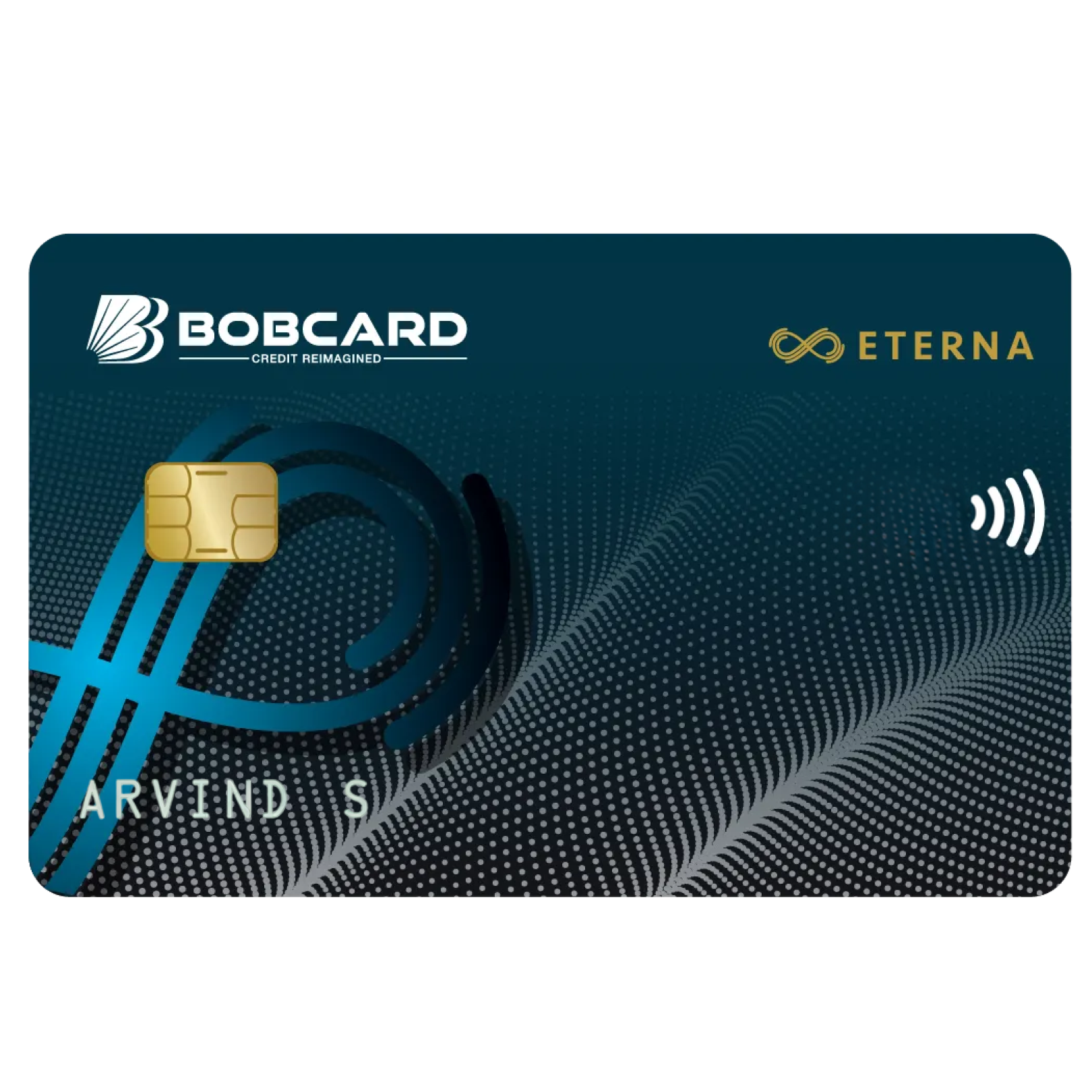
A lower interest rate matters most when you need flexibility. BOBCARD is built with competitive finance charge rates, transparent fee disclosures, and tools to help you manage your balance smartly, whether you pay in full every month or occasionally need a little more time.
From EMI conversion to auto-pay setup and real-time alerts, BOBCARD gives you the tools to stay ahead of interest charges, not catch up to them.
Apply for BOBCARD today and choose a credit card built around your financial wellbeing.
Frequently Asked Questions
Disclaimer
The information in this blog is for general educational and informational purposes only. Interest rate figures are indicative and based on publicly available bank information as of the date of publication. IDFC FIRST Bank and YES Bank rates cited are subject to individual creditworthiness assessment and may not be available to all applicants. Actual rates applicable to your credit card are specified in your card agreement and the Most Important Terms and Conditions (MITC) document. Balance transfer promotional rates are time-limited and subject to the issuing bank's current offer terms. Readers are advised to verify current rates and eligibility directly with the relevant bank. This content does not constitute financial advice.